
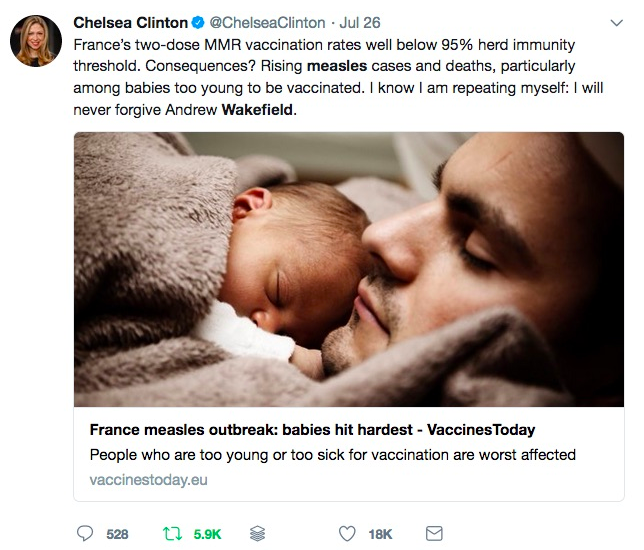
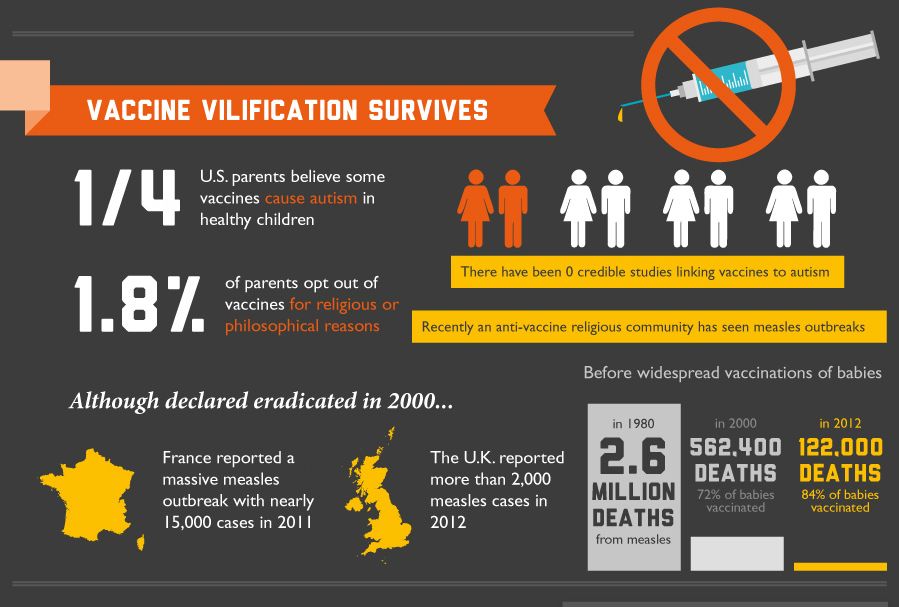
Last week, I discussed hesitancy towards the miracle that is vaccination. I mentioned how many parents are hesitant to vaccinate their children due to skepticism. This skepticism is due to alleged links made between certain vaccines and cognitive development. This week, I will be discussing the man who is pretty much the literal driving force behind vaccine hesitancy– Mr. Andrew Wakefield.
Wakefield’s Experimental Method
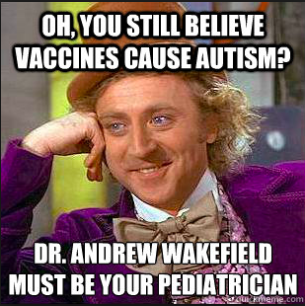
According to a Science-Based Medicine post, Andrew Wakefield is a British scientist who, in 1998, published an experiment in the Lancet paper. Wakefield’s experiment almost instantly triggered the anti-vax movement (which is still a thing people!!) because his “results” “indicated” that the MMR vaccine is “linked” to autism. I use quotes because it turns turns out that his “experiment” was bogus. According to an NCBI post, Wakefield picked and choose the results that corresponded with this hypothesis, had an insignificant sample size, and received bias funding for the project. His paper indicated a close connection between the MMR vaccine and autism, a mental disability resulting in poor cognitive development and communication, in children. This had a big impact on the public because upon the release of this paper, MMR vaccination rates went down, according to the NCBI article. We know from my last blog post that this left a lasting impact that we still see today, over 20 years later. People are skeptical about getting vaccines, causing their rates to go down. Of course vaccines aren’t perfect but I think its completely unacceptable to publish scientific findings and influence the world in a false way. I really have no sympathy for this man lol.
According to his Lancet paper, Wakefield experiment started with a question as to whether historically normally-developed children could get digestive tract inflammation and/or regressive development when given the Measles, Mumps, and Rubella vaccine (MMR). His hypothesis was essentially that an inflamed digestive tract caused by MMR leads to “behavior change in some children”, aka mental issues. His experiment consisted of an insignificant sample size of only 12 children, aged 3-10. He claimed to have compared his experimental results to five colon biopsies of healthy children, around the same age and location of his test children. There was no controlled group studied, meaning no untreated group of children were arranged in Wakefield’s experiment to compare results between treated and untreated children. This makes his “results” that much more inaccurate. Data was collected when monitoring the vaccinated children for months, indicate bowl and behavioral changes that occurred. The children’s physicians and parents observed major changes in behavior, interactions, and mood and this data was recorded. His data indicated general abnormal changes in behavior and bowl months after vaccination. Wakefield then concluded that, indeed, there was a strong positive correlation between MMR vaccines in children and the onset of digestive inflammation and cognitive regression. His hypothesis was correct according to his “findings”. He went on to share this precious information with the world by publishing it to Lancet journal.
Many things about Wakefields experiment, as I mentioned, were both unethical and experimentally wrong. The children included in his study actually all had a history of autism PRIOR to Wakefield’s experiment, according to the Science-Based Medicine article. That means he choose children who literally ALREADY HAD the illness that he was trying to prove that MMR would give them.
An important aspect of many experiments is called a double-blind procedure. A double-blind experiment means neither the participants nor the experimenter knows who is treated and who is not. As you can imagine, this ensures that all results and observations aren’t coming from a preconceived expectation/biases. In Wakefield’s study, this was not the case according to a The Guardian article. Both Wakefield and the children involved knew about the treatment being imposed and therefore were aware of what is “expected” to happen (behavioral changes, etc). If you expect something to happen you will look for it, skewing the accuracy of results! This is yet another factor that makes his experiment not credible. Wakefield, through just one experiment, truly altered the world’s perception on vaccines.


 Microbiology for Smarties